Is that a revision or a new deliverable?
Compare feedback with the agreed brief, clarify review rounds, and record a scope decision before turning a changed request into billable work.
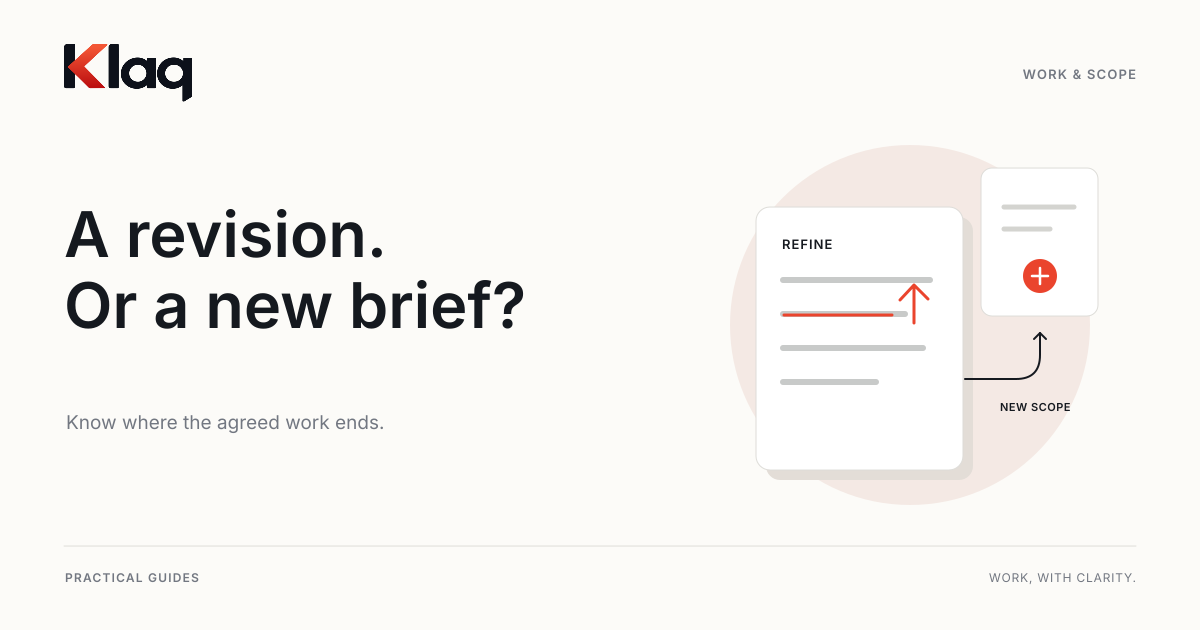
Judge a revision against the deliverable and requirements the client already agreed to review. Feedback that improves that work belongs in the review conversation. A request for a different output, a changed requirement, or work beyond the agreed review process needs a separate scope decision. Do not decide from the word "small" or assume every requested change deserves an extra invoice.
Locate the boundary in the actual brief
Put the request beside the agreed deliverable, the current version, and the requirements being reviewed. Ask what the client wants changed and why. The useful comparison is between those records, rather than between your impression of the effort and the client's description of the request.
A revision may still involve substantial effort. An addition may be straightforward to implement. Classify the request first, then estimate the effort and discuss the effect on delivery. Otherwise, "quick" can become an accidental substitute for "included," while a difficult correction can be treated as extra work without examining the original commitment.
Adobe's guidance on conducting a design review defines the session around project requirements, outcomes, constraints, and the work under review. It distinguishes that evaluation from reopening approved items or extending the requirements. This provides a concrete review framework, rather than a rule that the supplier can reject any feedback they dislike. Adobe's design-review guidance.
A useful example: design work and supplied copy
Adobe's creative-project planning guide uses a brochure as an example of why scope should identify whether the client supplies copy or the project includes producing it. The same guide recommends an identified change-control process when scope changes, including additional revision rounds. That example makes the distinction tangible: the output being discussed and the work included in producing it both need to be clear. Adobe's creative-project planning guide.
For your own brief, check the equivalent boundary before responding. Do not assume that a service is included merely because it contributes to the finished output, and do not assume it is excluded merely because you did not list the task internally. Read the wording and discuss ambiguity with the client.
Ask what a review round actually includes
A useful operational question is whether a review means a consolidated set of feedback on an identified version, a meeting, or ongoing comments as work develops. Agree which meaning applies rather than relying on the phrase alone.
Identify the version under review, who collects feedback, and when the team has a coherent response to act on. Keep any later request connected to that record so you can tell whether it clarifies an existing comment or introduces a different decision.
This is an editorial process suggestion, not a claim that a particular number of rounds is standard or that a deadline silently removes a client's rights. The agreement remains the relevant reference for what was included and how changes are handled.
Separate conflicting feedback from changed scope
If reviewers disagree, resolve the decision before treating the disagreement as a production task. Ask who can settle the direction and whether that person has seen the competing comments. A list of tasks does not explain which instruction the team should follow.
Adobe's client-approval guide recommends identifying stakeholders and final sign-off responsibility, making feedback expectations clear, and keeping input centralized. These are useful elements of a real approval workflow; they do not imply that a collaboration tool independently accepts a new fee on the client's behalf. Adobe's client-approval guide.
A small team can use a short decision record: requested outcome, relevant brief or version, decision owner, and next action. Keep the language descriptive. Calling a request scope creep before clarifying it can make the record less useful than explaining the specific difference you need to resolve.
Turn an agreed change into visible work
Once the direction is clear, update the work plan to reflect it. Keep the original commitment distinguishable from an agreed addition. Record the effect on delivery and discuss the billing treatment through the process you use with the client.
Klaq's project-estimate and scope-change guide explains how task records can represent changed work while estimates remain internal planning information. Updating a task estimate does not automatically secure client acceptance or change an issued invoice.
If a new estimate is appropriate, use the document to describe the work you are proposing. The estimate-to-invoice workflow can carry that document content forward when billing is ready, but conversion is not itself an approval event. Keep the commercial decision attached to the actual client discussion.
If your team already uses the Klaq app, connect the agreed request to the relevant project tasks and recorded work. The record should help another person understand why the activity exists, rather than rely on the label "revision" to explain it.
Keep the billing explanation traceable
Before billing additional work, review what the client actually agreed and what the team performed. Correct incomplete time records while the workflow allows it. Use the time-entry review guide to understand the recording and correction step, rather than rewriting a record to match the charge you hope to make.
Where the engagement uses hourly billing, approved-time import prepares eligible completed, billable, approved work as an invoice draft. That import is a billing handoff. It does not decide whether a change was included in the original scope.
Editorial opinion: explain the difference before naming it
I recommend describing the requested output and its difference from the agreed brief before debating whether it is a revision. That gives the client something concrete to confirm or correct. It also leaves room to discover that your interpretation of the brief was incomplete.
A clear change discussion can acknowledge a useful client idea without promising to absorb it silently. Equally, it can acknowledge a correction without presenting normal review work as a new service. The label should follow the explanation.
Limitation: a checklist cannot interpret every agreement
This process organizes the work and discussion; it does not decide the legal effect of your terms or settle every disagreement about quality. Some requests need professional contractual advice or a direct commercial compromise. A task status, time approval, or document conversion cannot supply an agreement that the records do not establish.
FAQ
Is a difficult change automatically outside scope?
No. Compare it with the agreed requirements and review process. Effort matters when planning the work, but it does not by itself establish whether the activity was included.
Does a small request have to be free?
No universal rule follows from its size. Identify what was requested and how the agreement treats it. Discuss any change to price or delivery before representing it as agreed additional work.
What should I do with conflicting client comments?
Identify the person who can settle the direction and bring the conflict back to them. Record the agreed outcome before turning competing instructions into tasks.
Does changing a Klaq task estimate approve a new fee?
No. An internal task estimate supports planning. Client acceptance of commercial changes must come through the appropriate agreement process, and issuing an invoice remains a separate step.
About the author

Mohamed Ajmal — Engineer. LinkedIn