Hourly or fixed price when the scope is unclear?
Compare hourly and fixed-price commitments, identify unresolved scope, and keep effort estimates separate from the price agreed with a client.
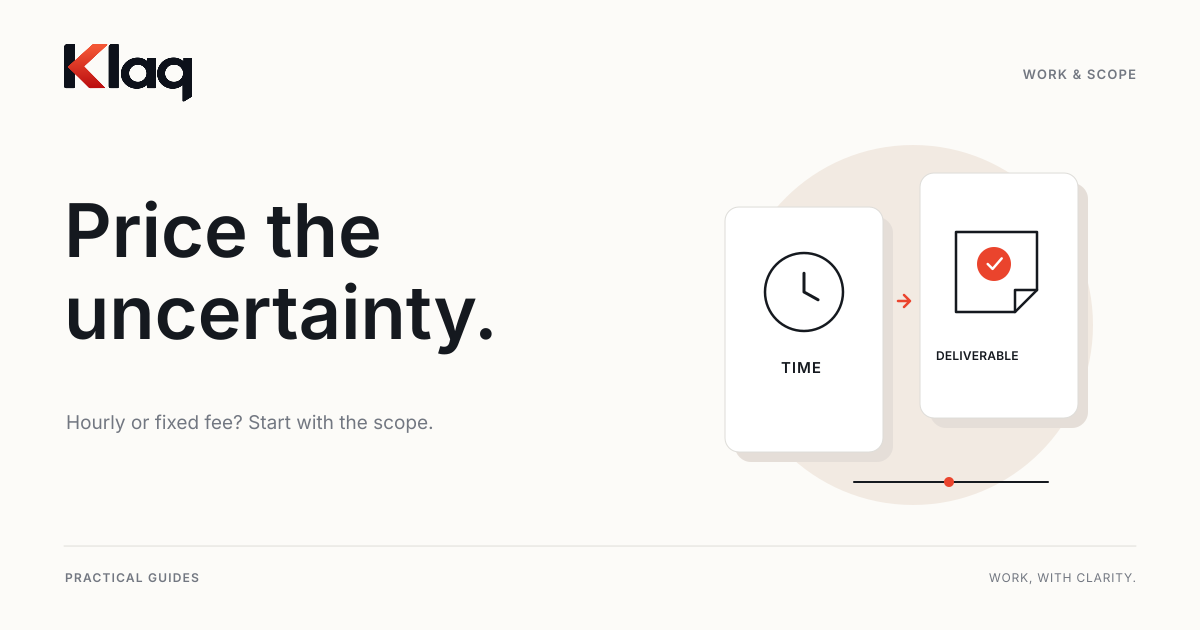
When a project's scope is unclear, choose a billing model that makes the uncertainty visible. Hourly work can fit changing requirements if you agree which activities are chargeable and when to review progress. Fixed-price work needs a defined result and a way to handle changes. If neither can be described yet, my recommendation is to agree a bounded discovery phase before pricing the full engagement.
Identify the uncertainty you are pricing
Before comparing rate formats, write down what is still unknown. Is the deliverable unclear, is the client's input missing, or is the implementation effort uncertain despite a clear result? These questions help you decide what the next agreement needs to establish.
An unclear output and an uncertain effort estimate are different planning problems. You can describe a result without knowing every task it will require. You can also know the tasks while the client has not decided which result they want. Name the unknown explicitly before putting a price around it.
Ask who will resolve each uncertainty and what information they need. Keep that responsibility visible alongside the delivery work. The point is to define a practical decision process, not to predict an outcome that the available evidence cannot support.
What hourly and fixed-price models commit you to
Upwork's official comparison describes hourly contracts as payment for logged time, with options for how time is recorded and a weekly limit. It positions that model for ongoing or changing work. Its fixed-price model uses defined deliverables or milestones, with a different funding and review process. Those are Upwork-specific mechanics; they are not features automatically provided by another invoicing app. Upwork's contract-type comparison.
Harvest illustrates the underlying distinction in its own project types. Time-and-materials billing follows recorded hours and rates, while a fixed fee remains a set price regardless of recorded hours. Its documentation also describes an internal comparison showing what a fixed-fee project would have produced if billed hourly, where configured. That example separates reviewing effort from changing what the customer is charged. Harvest's project-type documentation.
Neither model answers the scope question for you. Use the examples to compare the commitment you are making, then describe your own engagement in language the client understands.
Compare the working decisions
For an hourly engagement, agree the chargeable activities, how time will be recorded, who reviews progress, and when further work needs discussion. A budget or hours ceiling should be described as a control on the engagement, rather than left as an implied promise that every desired outcome will fit inside it.
For a fixed-price engagement, specify the deliverable, the inputs the client must provide, how review works, and what is excluded. Decide how a changed request will be considered. The useful question is whether both parties could identify completion from the description, without relying on an unstated interpretation of what a finished project ought to include.
For discovery, define the decision or evidence that phase is intended to produce. Keep that phase bounded and useful on its own. Its output should give both parties something they can assess before choosing the next commitment.
These are proposed planning questions. They do not establish a universally correct pricing model or imply that a particular structure guarantees a profitable engagement.
Keep the estimate separate from the price
An internal effort estimate can support planning under either model. Keep it attached to the tasks it describes and review it against recorded work. When the estimate changes, document the reason before treating the change as a commercial decision.
Klaq's project-estimate guide distinguishes overall project estimates from the estimates for individual tasks. It also explains why a parent's estimate should not include work already represented by a subtask estimate. Those are useful controls when reviewing a plan whose details are becoming clearer.
The same guide states that an internal estimate does not determine what the customer owes. Klaq's project records can organize a discussion about added work, but they do not automatically obtain acceptance of a new price. Keep that boundary clear even when the working estimate and proposed fee happen to use the same language.
Preserve the billing model when preparing documents
Review the document against the engagement you agreed. If you promised a fixed deliverable, do not turn the internal time record into an hourly invoice simply because the work took longer. If the work is hourly, check that the selection and descriptions explain the activities included in that period.
Klaq's estimate-to-invoice workflow preserves document content through a conversion, but the conversion itself is not customer approval. Use it to prepare the next document only when the underlying billing decision is ready.
For an agreed hourly workflow, approved-time import uses eligible completed, billable, approved entries and checks customer and currency. It produces an invoice draft for review. It does not provide Upwork's marketplace funding or payment-protection process, and recording time is not the same as collecting payment.
If your team already uses the Klaq app, keep the project tasks, recorded effort, and billing documents connected there. Review them against the agreement before using the invoice review checklist to close out the billing work.
Editorial opinion: price the next clear commitment
I prefer a smaller, explicit commitment over a broad fixed price that hides unresolved decisions. When the outcome is uncertain, agree what you can reasonably investigate or deliver next, then use that evidence to discuss the following phase.
That is an editorial preference about managing uncertainty, not a claim that hourly or phased work always earns more. A clear fixed-price deliverable can be a sensible commitment even when some implementation details remain unknown.
Limitation: the model cannot repair a weak agreement
A pricing format cannot resolve unclear responsibilities, missing client inputs, or an unresolved dispute about completion. Platform protections and contractual consequences also vary. This comparison helps organize a business discussion; it does not determine the legal effect of a particular contract or guarantee payment, margin, or client satisfaction.
FAQ
Is hourly billing always better for unclear scope?
No. It can accommodate evolving work, but the chargeable activities and review process still need agreement. An unclear objective can remain unclear under hourly billing, so decide what the next phase is intended to establish.
Can fixed-price work use milestones?
Yes. Upwork's fixed-price model is an actual example of milestone-based work. In your own engagement, specify the deliverables and review process explicitly rather than assuming another tool provides the same funding or approval mechanics.
Does tracking time change a fixed fee?
No. Recorded effort can inform internal planning and later estimates. A different charge needs an appropriate commercial decision; it does not follow automatically from an increase in the time record.
Does a Klaq estimate conversion prove client acceptance?
No. Conversion prepares an invoice from the estimate. It does not itself establish that the client approved the work, price, or any subsequent change.
About the author

Mohamed Ajmal — Engineer. LinkedIn