Plan client coverage when team leave overlaps
Review approved availability, assign client handovers, and check coverage before overlapping team leave affects delivery commitments.
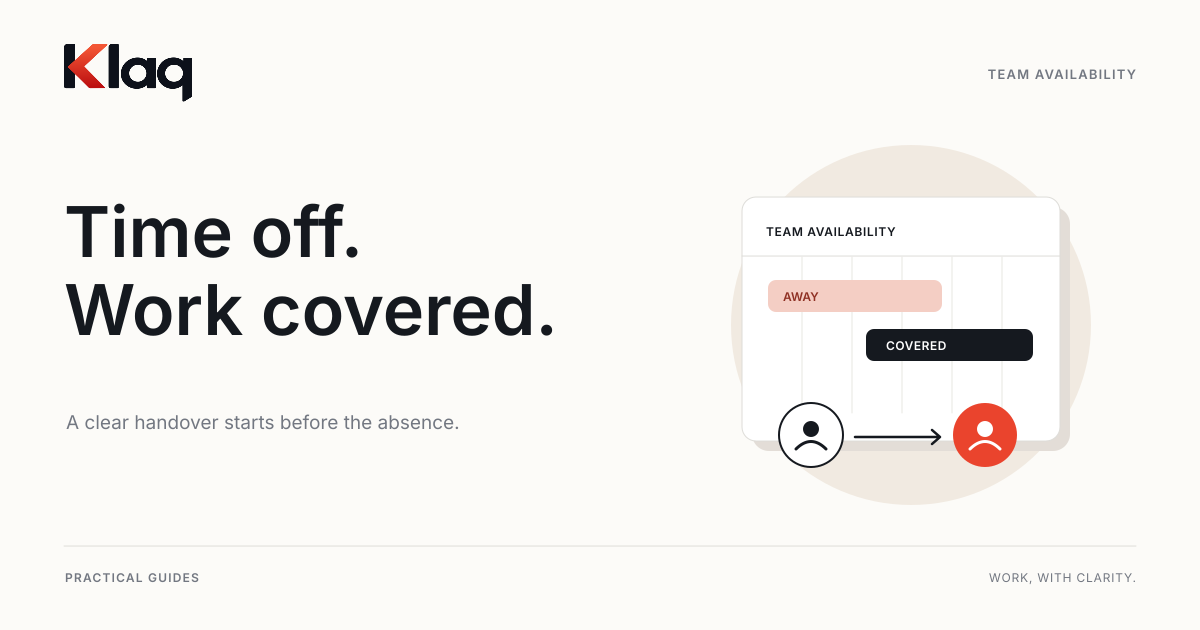
Plan client coverage for overlapping leave by identifying the work that must continue, assigning a named available owner, and reviewing the handover before the absence begins. Use approved leave records to understand availability, then confirm who can handle each commitment. A shared calendar shows absence; it does not, by itself, establish that client work is covered.
Start with commitments that cannot wait
Begin the coverage review with client work due during the proposed absence. Review the delivery dates, review meetings, promised responses, and decisions that may need attention. Distinguish those commitments from work that can reasonably move, then discuss any proposed change with the appropriate people.
Do not turn this review into an assumption that every task must continue unchanged or that someone on leave will remain available. The purpose is to find an agreed coverage plan while the people responsible for the work can still explain its context.
For each commitment, ask who can make progress, what information they need, and who can make a decision if the normal owner is unavailable. Keep unresolved gaps visible. A name in a handover note is not enough if that person has not accepted the responsibility or cannot access the relevant record.
What managers' public accounts illustrate
A public discussion among managers describes competing approaches to overlapping time-off requests, including visible calendars, written processes, and different ways to allocate popular dates. The responses disagree on which policy is fairest. Treat those accounts as examples of operational choices, not evidence that any particular rule suits every team or jurisdiction. The managers' discussion.
That disagreement is a reason to make your own decision process explicit before a conflict appears. Keep that policy question distinct from the delivery question: once someone's absence is approved, the team still needs to know how relevant client commitments will be handled.
This article focuses on that delivery handover. It does not recommend a universal staffing ratio, a priority system for leave, or a rule about which personal reasons deserve approval.
Use the actual leave state
A pending request and an approved absence are different records. In Klaq, a pending request reserves allowance while an independent owner or administrator reviews it. That reservation can affect available balance before approval. It should not be read as though the absence has already been approved. See how pending leave affects balances.
Klaq's time-off request guide explains that the workspace schedule, policy, and holidays affect the request calculation. The shared calendar gives limited availability information; it does not expose other members' private reasons, balances, or decision details.
Use that limited availability view for planning and keep private explanations out of ordinary client handover notes. The receiving colleague needs to understand the work they will handle, not personal information that is unrelated to the commitment.
Make the handover useful to its recipient
Review the handover with the person taking responsibility before considering it complete. Ask them to locate the latest work, explain the next action, and identify the decision they would need help with. Use the discussion to find missing context before the original owner becomes unavailable.
A practical handover note can include:
- The client and project the work belongs to.
- The current status and the next agreed action.
- The latest relevant file or record.
- A commitment that falls during the absence.
- The person responsible for progress and the person responsible for escalation.
- An unresolved issue that must be clarified before handover.
This is a proposed checklist, not a claim that every item belongs in every client's record. Keep it proportionate to the work and avoid copying confidential material into a broader channel merely to make the note look complete.
If your team already uses the Klaq app, review the project and task records together so the handover points to the current work. That use supports the conversation; it is not a claim that a leave request automatically redistributes tasks or notifies every affected client.
Set expectations for people contacting the absent owner
Decide what a client should do if they contact the normal owner during the absence. Confirm that any alternative contact is appropriate and available before referring people to them. Review the message against the actual coverage plan rather than promising a response the team has not agreed to provide.
Microsoft's Outlook documentation provides a concrete communications example: supported automatic replies can be scheduled for a time range and can use different messages for internal and external audiences. The setup depends on the account and Outlook version. That feature communicates absence; it does not confirm that an alternative contact has accepted the work. Microsoft's automatic-reply documentation.
Review the message alongside the handover. Keep the response useful to its audience, and avoid disclosing private reasons for the absence. Verify the relevant account's available settings instead of assuming every email setup behaves like the documented example.
Recheck the plan when approved leave changes
A proposed cancellation can change the working conversation before it changes the official absence record. In Klaq, asking to cancel approved leave does not immediately remove the absence or reverse its consumption. The original approved state remains until the separate cancellation decision is approved. The approved-leave cancellation guide explains that workflow.
Continue planning against the recorded state while the decision is pending. If the state changes, confirm the effect on the handover with the people involved. Do not assume that an updated calendar silently tells each client or colleague what they should now do.
Editorial opinion: review coverage, not just the calendar
I recommend treating the handover as a short work review with the receiving colleague. A calendar is useful for finding an overlap, but the coverage decision becomes concrete only when the responsible people can identify the work and the next action.
Keep that review focused. A small, current note with an accepted responsibility is more useful to this process than a broad archive that the recipient has not had time to understand. That is an editorial judgment about usability, not a measured claim about team performance.
Limitation: availability does not prove capacity
This workflow cannot establish that a colleague has enough time or the right authority simply because they are not on leave. It also does not determine leave entitlements, legal obligations, or the correct decision on an individual request. Review those questions under the applicable policy and circumstances; use the coverage record to describe the operational plan honestly.
FAQ
Does a pending Klaq request mean someone is approved to be away?
No. Pending leave reserves allowance while awaiting a decision. Plan with the distinction visible instead of treating the request status as an approval event.
Can the team calendar show the private reason for an absence?
Klaq's shared calendar exposes limited availability information. Private reasons, balances, and decision details remain restricted. Keep personal information separate from normal client handover notes.
Does an out-of-office message complete the handover?
No. It communicates absence. The proposed alternative contact still needs the context, access, availability, and responsibility required to handle the work.
Can I remove coverage as soon as approved leave is cancelled?
Check the actual decision state first. In Klaq, a cancellation request does not itself reverse an approved absence. Confirm any resulting change with the people responsible for the work.
About the author

Mohamed Ajmal — Engineer. LinkedIn